The engine throttle cable on the JCB 3CX and 4CX Backhoe Loader is routed from the left-hand (L.H.) side of the engine compartment and connects to both the foot pedal and the hand throttle lever located inside the right-hand (R.H.) side console.
If the throttle cable becomes damaged, stiff, loose, or unresponsive, replacing it can restore proper throttle control and improve machine operation.
This guide explains the correct procedure for removing and replacing the throttle cable on JCB 3CX and 4CX backhoe loaders.
Related Diagnostic Tools for JCB Equipment
- JCB Service Master Diagnostic Tool
- JCB Electronic Service Tool
- JCB Heavy Equipment Diagnostic Software
- 2025 JCB ServiceMaster 4 v25.07 Free Download for Win 10 Win11
JCB 3CX 4CX Engine Throttle Cable Removal Procedure
Step 1: Prepare the Machine
Before beginning the repair:
- Park the machine on firm, level ground.
- Apply the parking brake.
- Lower the loader arms and excavator attachment to the ground.
- Switch OFF the engine.
- Remove the starter key.
For safety, allow the engine to cool before working in the engine compartment.
Step 2: Open the Engine Compartment
Open the bonnet and remove the engine side covers to gain access to the throttle cable routing.
Step 3: Disconnect the Cable from the Fuel Injection Pump
At the left-hand side of the engine compartment:
- Locate the throttle cable connection at the fuel injector pump lever.
- Loosen the lock nut C.
- Unhook the throttle cable from the fuel injector pump lever D.
- Feed the cable end back across the engine compartment toward the bulkhead on the right-hand side.
Step 4: Disconnect the Cable from the Foot Pedal
Working on the right-hand side of the engine compartment near the bulkhead:
- Remove screws E.
- Carefully pull back the rubber bulkhead cover.
- Locate the foot pedal lever connection.
- Remove nut F.
- Disconnect the cable pivot block from the foot pedal.
Next:
- Loosen lock nut G.
- Release the cable from the mounting bracket.
- Feed the cable back underneath the cab toward the rear wheel arch on the right-hand side of the machine.
Step 5: Access the Hand Throttle Lever Assembly
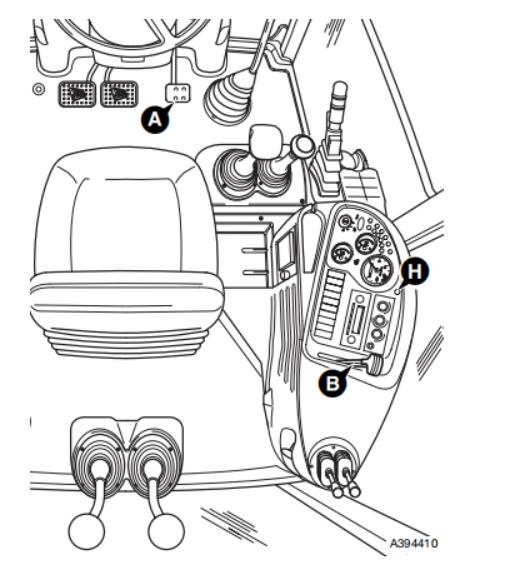
Inside the cab:
- Remove fixing H located at the top of the instrument panel.
- Carefully lift the instrument panel forward.
- This will expose the hand throttle lever and mounting bracket assembly J inside the side console.
Take care not to damage the wiring or dashboard components during removal.
Step 6: Remove the Hand Throttle Lever
- Remove the hand throttle lever knob.
- Remove screws K.
- Hold the hand throttle lever assembly securely.
- Withdraw the handle through the slot in the panel.
Step 7: Remove the Throttle Cable
From inside the side console:
- Carefully pull the throttle cable upward.
- Remove the cable through the aperture in the cab floor.
The throttle cable is now fully removed.
JCB 3CX 4CX Throttle Cable Replacement
Install the new throttle cable by reversing the removal procedure.
When installing the replacement cable:
- Ensure the cable routing matches the original layout.
- Avoid sharp bends or cable kinks.
- Tighten all lock nuts and mounting hardware securely.
- Confirm the cable moves smoothly through its full range.
Final Inspection and Adjustment
After installation:
- Operate both the hand throttle and foot throttle controls.
- Check for smooth throttle movement.
- Verify the throttle returns correctly to idle position.
- Ensure the fuel injection pump lever operates normally.
If throttle movement feels stiff or uneven, inspect the cable routing and bracket alignment again.
Common Symptoms of a Faulty JCB Throttle Cable
A damaged or worn throttle cable may cause:
- Slow engine response
- Sticking throttle pedal
- Hard throttle operation
- Engine speed fluctuation
- Poor hand throttle control
- Incomplete return to idle
Replacing the throttle cable can help restore proper engine speed control and improve machine performance.
Conclusion
Replacing the engine throttle cable on a JCB 3CX or 4CX Backhoe Loader is a straightforward maintenance task when performed carefully. Following the correct removal and installation procedure helps ensure reliable throttle operation and prevents future control issues.
For advanced diagnostics, calibration, and repair procedures, professional JCB diagnostic tools and service software are highly recommended.
More heavy equipment diagnostic tools and repair solutions are available at: