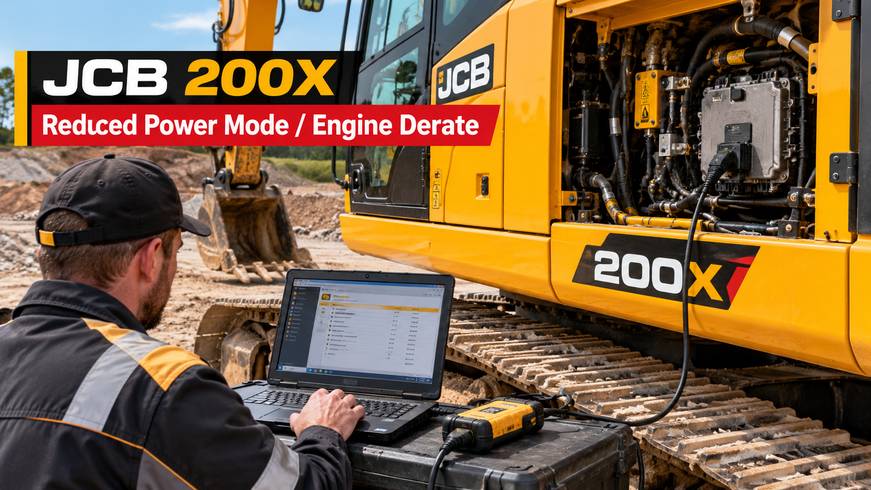
A JCB 200X Series excavator may enter Reduced Power Mode, also known as an engine derate, when the engine ECU or aftertreatment control system detects a fault that could affect engine protection or emissions compliance.
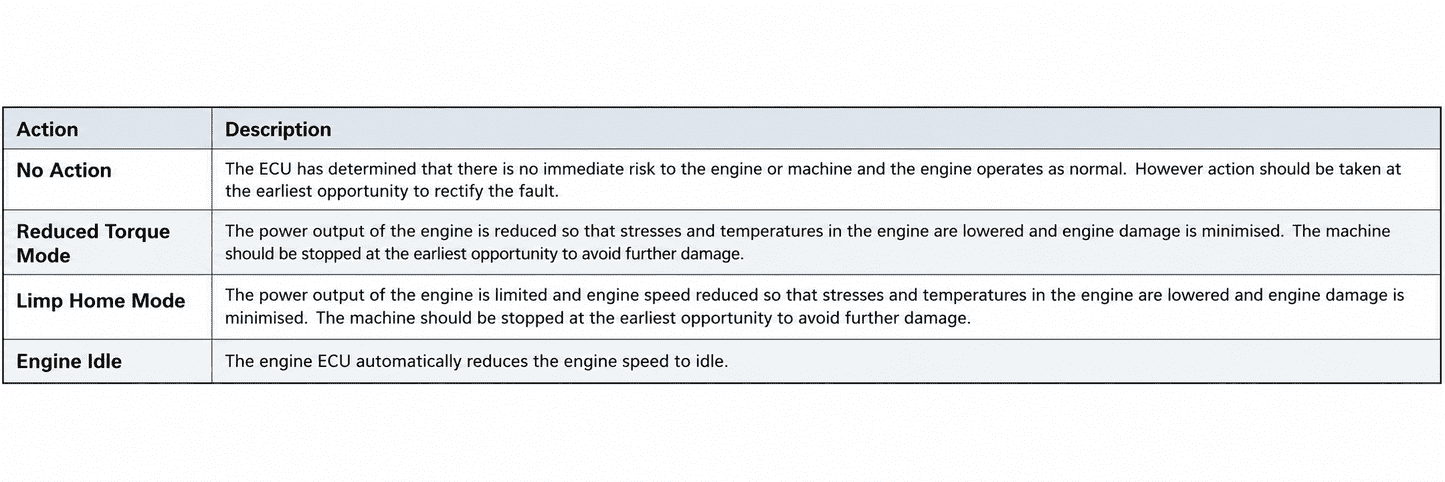
Depending on the fault type and severity, the ECU may limit engine torque, restrict engine speed, or eventually force the engine to idle.
Image:
Why Does a JCB Machine Enter Engine Derate?
The engine ECU continuously monitors the engine and emissions-control systems. When it detects a significant fault, it determines the required protective action.
On Tier 4 Final / Stage IV machines, many derate events involve the SCR and DEF aftertreatment system.
The inducement strategy prevents continued operation when the emissions-control system cannot operate correctly.
Common causes include:
- Low DEF level
- Incorrect or contaminated DEF
- DEF dosing interruption
- SCR or aftertreatment faults
- Suspected aftertreatment system tampering
- EGR flow or emissions-system faults
- Communication problems between the engine ECU and aftertreatment controller
- Software or calibration mismatch between related control modules
The exact derate strategy can vary by machine configuration, engine, software calibration, and emissions standard, so always check diagnostic trouble codes before replacing components.
JCB DEF Level Inducement
DEF level is one of the most common conditions that can trigger an emissions warning and subsequent power reduction.
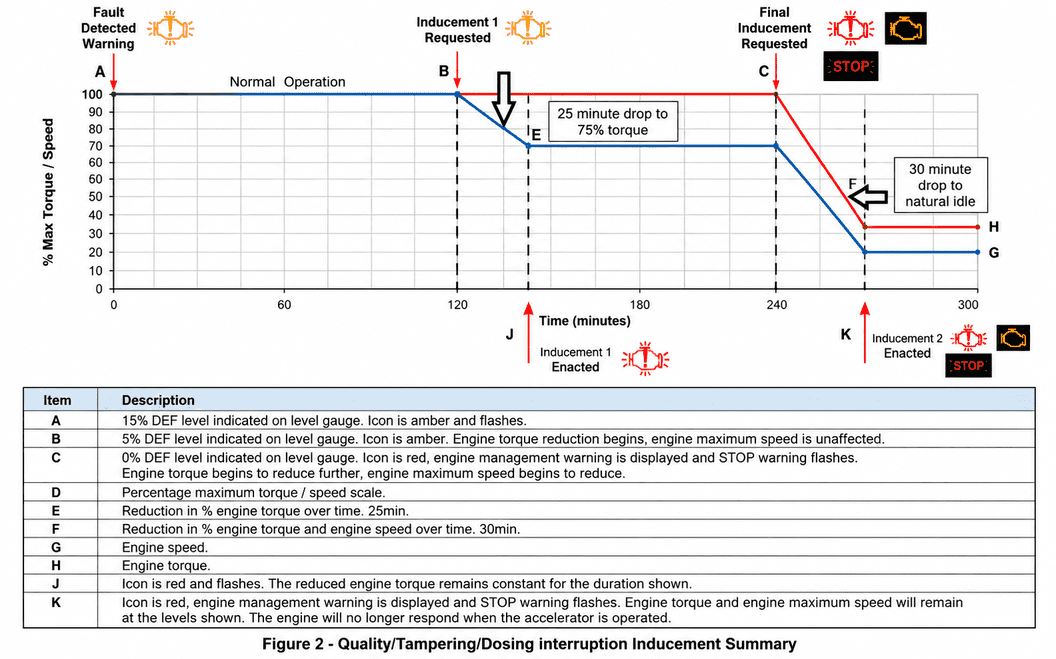
For the configuration described in this case, the inducement thresholds are:
- 10% DEF level: warning stage
- 5% DEF level: first derate stage
- 0% DEF level: final derate stage
Images:
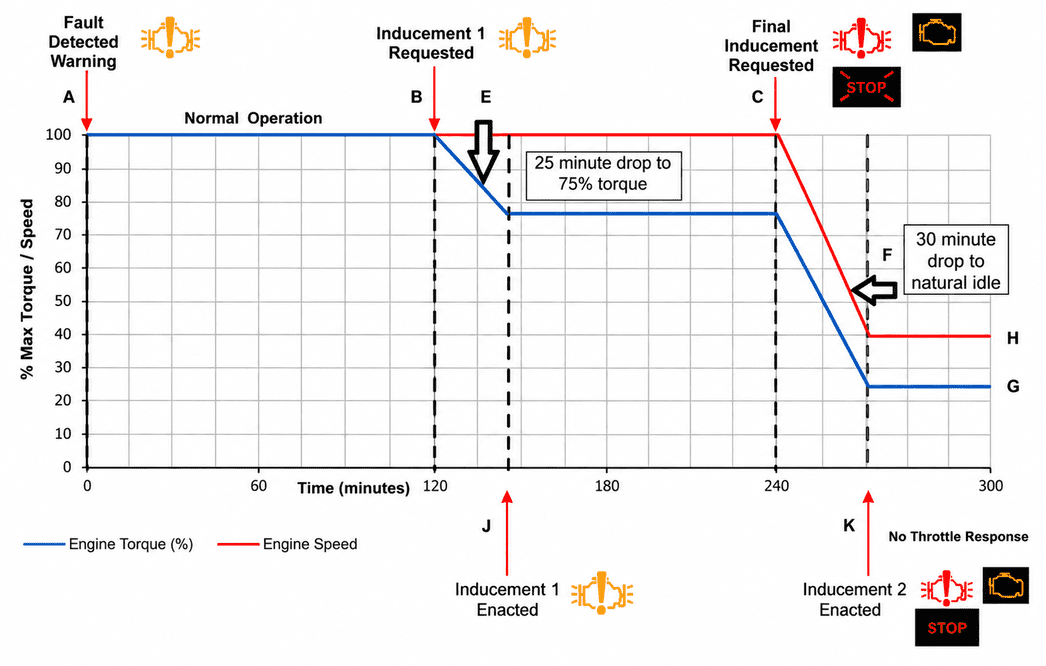
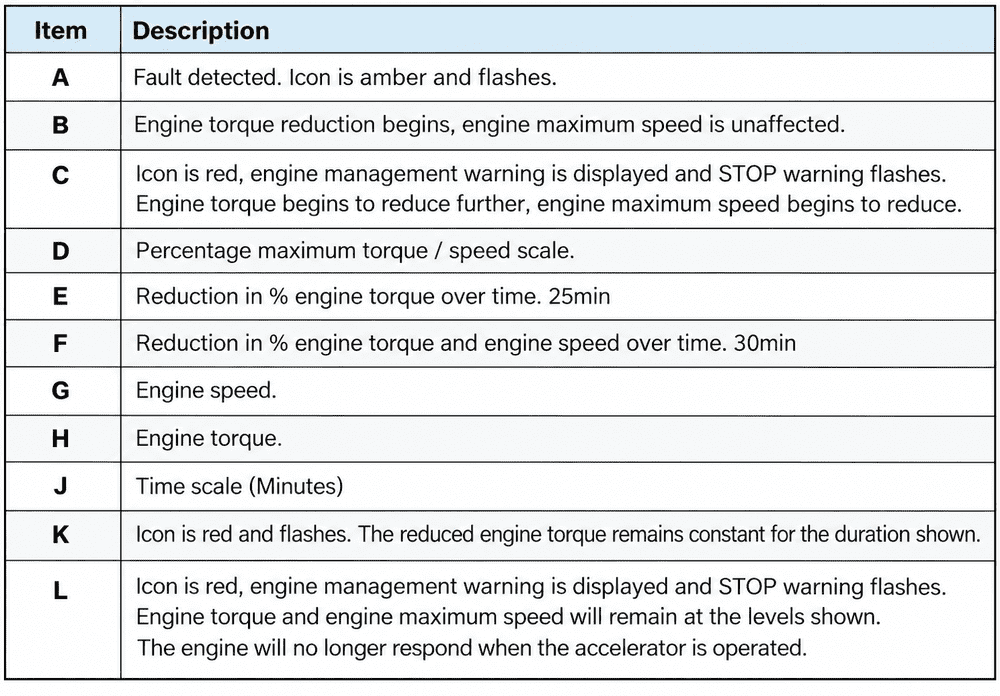
How the JCB Engine Derate Strategy Works
Once the engine ECU or aftertreatment DCU detects a qualifying inducement fault, an internal timer may begin.
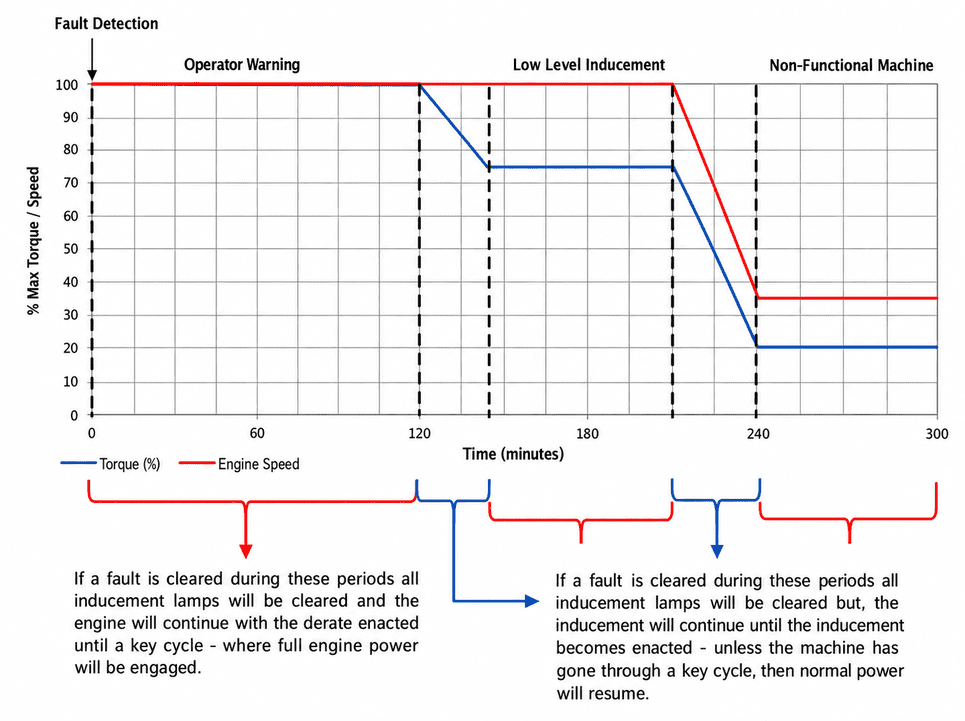
If the condition is not corrected, the machine can progress through increasingly severe derate stages.
Stage 1: Warning Period
The system initially allows approximately a 2-hour warning period.
During this period:
- The emissions warning lamp may flash amber.
- Normal machine operation may still be available.
- The operator should diagnose the fault before the derate progresses.
Ignoring the warning can allow the system to move to the next inducement stage.
Stage 2: Level 1 Torque Derate
If the fault remains active, the ECU may request a Level 1 torque reduction.
For the strategy described here:
- Torque can be reduced by approximately 25%.
- The derate may be phased in over approximately 25 minutes.
- The emissions warning lamp becomes solid amber.
At this point, simply clearing a fault code without repairing the root cause may not restore normal performance.
Stage 3: Final Derate / Forced Idle
If the inducement condition continues, the ECU can request the final derate stage.
In the example strategy, the final inducement is requested about 4 hours after the original inducement begins and may be applied for about 30 minutes.
The machine can then be restricted to very low engine speed or forced-idle operation.
Immediate Derate Caused by ECU/DCU Communication Problems
Not every JCB derate follows the normal warning sequence.
A machine may enter severe derate much sooner when there is:
- Loss of CAN communication between the engine ECU and aftertreatment DCU
- Incompatible ECU/DCU software
- Calibration mismatch
- Module power-supply problems
- Wiring or CAN network faults
In the configuration described in the original service information, this condition can immediately reduce available power to approximately 20% or force idle operation.
If this happens, do not assume the DEF system itself has failed. Check communication faults and module configuration first.
How to Diagnose a JCB Machine in Reduced Power Mode
Before replacing the DEF pump, NOx sensor, EGR valve, SCR components, or other expensive parts, connect a compatible diagnostic system and identify the active fault.
A practical diagnostic sequence is:
- Read all engine and aftertreatment diagnostic trouble codes.
- Record whether each fault is active, intermittent, or previously logged.
- Check DEF level and DEF quality.
- Review DEF pressure and dosing-related data where supported.
- Inspect EGR and aftertreatment-related live data.
- Check ECU-to-DCU CAN communication faults.
- Confirm battery and module supply voltages.
- Verify the machine configuration and controller software where relevant.
- Repair the root cause.
- Clear the faults.
- Perform the required key cycle or ECU power-latch procedure.
- Restart the machine and verify that full engine power has returned.
For JCB diagnostics, a compatible interface and JCB diagnostic software can help technicians read fault codes, view controller information, and confirm whether an induced fault remains active.
JCB diagnostic tool:
https://www.obd2tool.com/goods-4451-JCB-Electronic-Service-Tool-JCB-Diagnostic-Interface.html
Compatibility and available functions depend on machine model, engine, controller configuration, and software version. Confirm the required diagnostic functions before ordering.
JCB Fault Clearance and Power Restoration
Repairing the original problem does not always restore full engine power immediately.
The ECU may require a specific shutdown and restart sequence before it clears the inducement state.
ECU Power-Latch Cycle
For some inducement faults, the machine must complete an ECU power-latch cycle after repairing the fault.
If the controller has not completed the required shutdown sequence, the machine may remain derated even though the original diagnostic trouble code has been cleared.
Allow the machine electronics to shut down completely, per the applicable service procedure, before restarting.
Key-Cycle Recovery
Other faults may require one or more complete key cycles.
If the fault heals during the current operating cycle:
- The controller may need one cycle to recognize that the fault has healed.
- A subsequent cycle may be required before full power is restored.
For the DEF-level inducement strategy described here, two key cycles may be required before normal engine power returns.
Image:
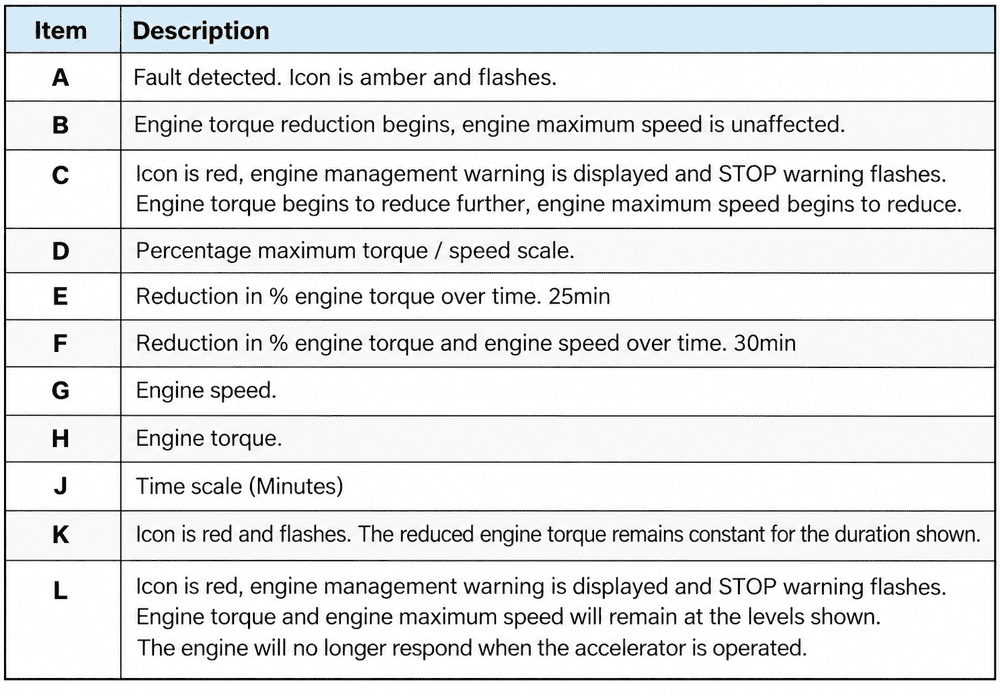
What If the Fault Returns Within 40 Engine Hours?
A recently repaired machine deserves additional attention.
For certain faults within the same inducement group, if the condition becomes active again within approximately 40 engine-running hours, the ECU may treat it as a repeated emissions fault.
Instead of restarting the full warning period, the system may request the final inducement stage much sooner.
In the example strategy described here, the system can request and apply an idle derate within about 30 minutes after the repeated fault becomes active.
That means you should not simply clear a returning derate again.
Check for:
- Intermittent wiring faults
- Loose connectors
- DEF contamination
- Weak pumps or dosing components
- Sensor drift
- CAN communication interruption
- Software/calibration mismatch
- Incomplete previous repair
JCB Reduced Power Mode Troubleshooting Summary
If your JCB 200X Series machine suddenly loses engine power, start with the fault codes instead of guessing which component failed.
The most important distinction is whether the machine is experiencing:
- A gradual emissions inducement
- Low DEF inducement
- A communication-related immediate derate
- A repeated inducement fault
- A fault that has already been repaired but has not completed the required power-latch or key-cycle recovery
Reading the engine ECU and aftertreatment controllers with the correct diagnostic equipment can significantly shorten troubleshooting.
Recommended JCB Diagnostic Resources
For technicians servicing JCB construction equipment, see:
JCB Diagnostic Tools and Service Equipment:
https://www.obd2tool.com/search-jcb.html
A compatible JCB diagnostic setup can assist with fault-code reading, controller identification, live-data analysis, and post-repair verification, depending on the machine and software configuration.
For additional repair cases and troubleshooting guides, see more JCB Machine Trouble Repair articles on OBD2TOOL.com.
FAQ
Why is my JCB excavator in Reduced Power Mode?
Common causes include low DEF level, DEF quality problems, SCR faults, EGR-related emissions faults, interrupted DEF dosing, and communication problems between the engine ECU and aftertreatment controller.
Will clearing the fault code immediately restore full power?
Not always. Some faults require an ECU power-latch cycle or one or more complete key cycles before full power is restored.
Can low DEF cause a JCB engine derate?
Yes. On applicable Tier 4 Final / Stage IV machines, low DEF level can trigger warning and inducement stages that eventually reduce engine torque or speed.
Why did my JCB immediately derate to idle?
An immediate severe derate can be associated with ECU/DCU communication loss, controller software mismatch, or another serious system fault. Read the complete fault-code list before replacing parts.
Why did the derate return after I cleared the codes?
If the underlying fault persists, the ECU can reactivate the inducement. Some repeated faults within the same inducement group may also trigger a faster final derate.
What diagnostic tool is used for JCB machines?
JCB-compatible diagnostic software and a supported communication interface can read control modules, retrieve fault codes, and inspect relevant live data. Confirm compatibility for the specific machine, engine, and diagnostic function required.