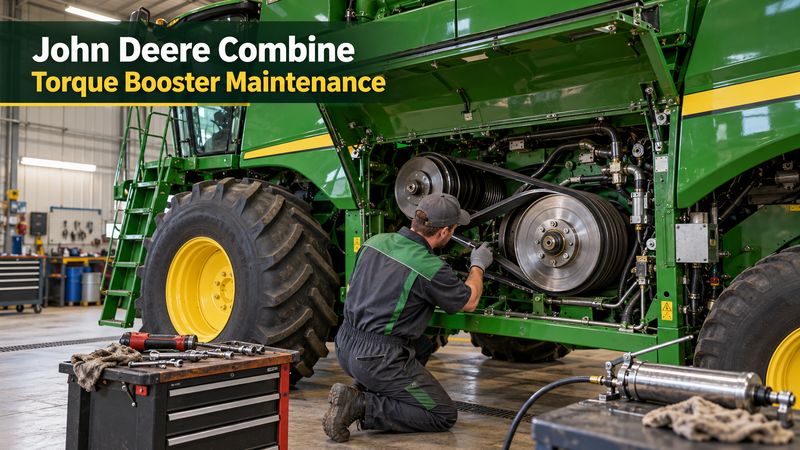
The torque booster in a John Deere 3518CT-S combine harvester plays an important role in the machine’s continuously variable drive system. Proper Lubrication of the movable sheave, springs, cam mechanism, needle bearing, and bronze bushing is essential to maintain smooth speed adjustment and prevent expensive belt-drive failures.
This guide explains how the torque booster works, where Lubrication is required, what happens when Lubrication is neglected, and what technicians should inspect when the combine develops CVT or drive-related problems.
Important: Always confirm lubrication type, grease quantity, service intervals, and adjustment specifications against the service information for the exact machine serial number.
How the Torque Booster Works
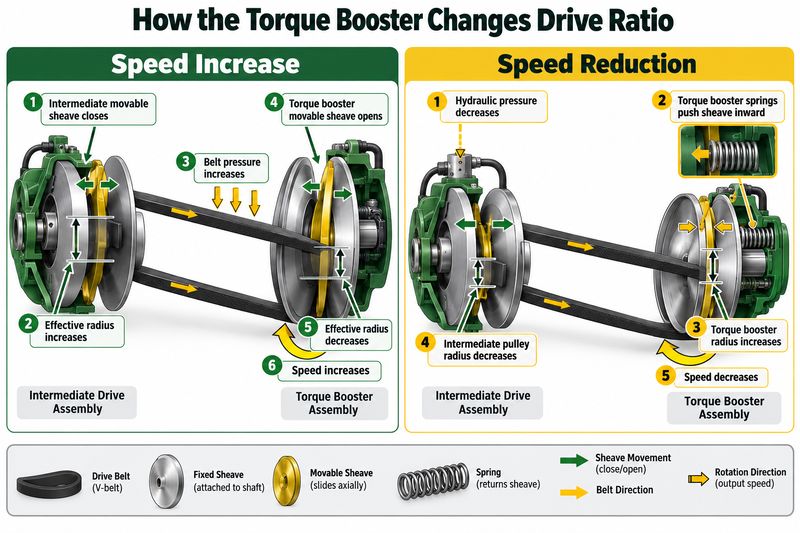
The torque booster changes the effective pulley diameter of the belt drive to adjust travel speed and transmit torque under changing loads.
During Speed Increase
When hydraulic pressure extends the speed-control cylinder:
- The movable sheave of the intermediate drive assembly moves toward the fixed sheave.
- The effective pulley radius increases.
- Belt pressure against the torque booster increases.
- The belt force compresses the springs inside the torque booster.
- The torque booster’s movable sheave moves outward.
- Its effective working radius decreases.
The resulting pulley-ratio change increases rotational speed.
During Speed Reduction
When hydraulic oil retracts from the cylinder, the process reverses.
The torque booster springs move the movable sheave toward the fixed sheave, increasing its effective radius. At the same time, belt force pushes the movable sheave of the intermediate drive assembly inward, reducing its effective radius.
The result is a lower drive speed.
How the Torque Booster Responds to Heavy Load
When travel resistance increases sharply, it requires additional torque.
If the belt begins to slip against the torque booster’s fixed sheave, the movable sheave and cam can rotate slightly relative to the fixed portion of the assembly.
This cam action pushes the movable sheave toward the fixed sheave and increases belt clamping force.
As belt grip increases:
Higher travel resistance → belt slip begins → cam mechanism reacts → pulley clamping force increases → belt slip decreases → more torque is transferred.
The intermediate drive assembly may also shift slightly as the drive ratio changes.
This mechanical response allows the belt-drive system to increase available torque when the combine encounters heavier operating conditions.
Critical Torque Booster Lubrication Points
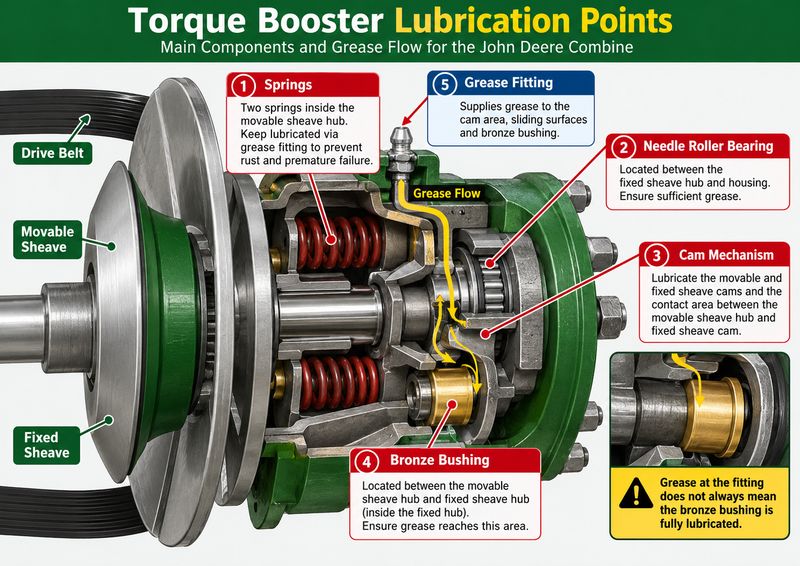
Correct Lubrication is one of the most important preventive-maintenance procedures for this assembly.
1. Torque Booster Springs
The surfaces of the two springs inside the movable sheave hub should remain adequately lubricated.
Grease is supplied through the designated grease fitting.
The purpose is not only to reduce friction. The grease also helps protect the springs against moisture and corrosion.
Rust on the spring surfaces can eventually cause:
- restricted spring movement
- uneven pulley operation
- reduced spring life
- spring failure
- poor CVT response
Inspect for corrosion whenever you service the assembly.
2. Needle Roller Bearing
A needle roller bearing is positioned between the fixed sheave hub and housing.
Make sure the bearing receives sufficient Lubrication.
A dry or contaminated needle bearing can cause:
- increased rotational resistance
- abnormal temperature
- rough pulley movement
- premature bearing wear
- damage to adjacent components
If grease is present but the bearing still feels rough or develops excessive play, inspect the bearing rather than simply adding more grease.
3. Movable and Fixed Sheave Cam Mechanism
The cam mechanism is one of the most important lubrication areas in the torque booster.
Its grease fitting supplies lubricant to several internal contact points, including:
- movable and fixed sheave cam surfaces
- the contact area between the movable-sheave hub and fixed-sheave cam
- the bronze bushing between the movable and fixed sheave hubs
The bronze bushing is located inside the fixed-sheave hub and can be particularly difficult for grease to reach.
Why Grease Selection Matters
Not every lubrication point operates under the same conditions.
General-purpose grease may be adequate for certain spring and bearing applications when allowed by the service specification. However, the cam and sliding-hub area experiences substantial pressure and movement.
A suitable lubricant should provide:
- good flow characteristics
- strong film strength
- resistance to oxidation
- stable viscosity across operating temperatures
- good adhesion to loaded sliding surfaces
The original maintenance experience for this application recommends a high-quality grease such as an appropriate Mobil product.
However, do not select grease solely by brand name. Use the grease specification recommended for the machine whenever that information is available.
Avoid mixing incompatible grease types.
What Happens When the Torque Booster Is Poorly Lubricated?
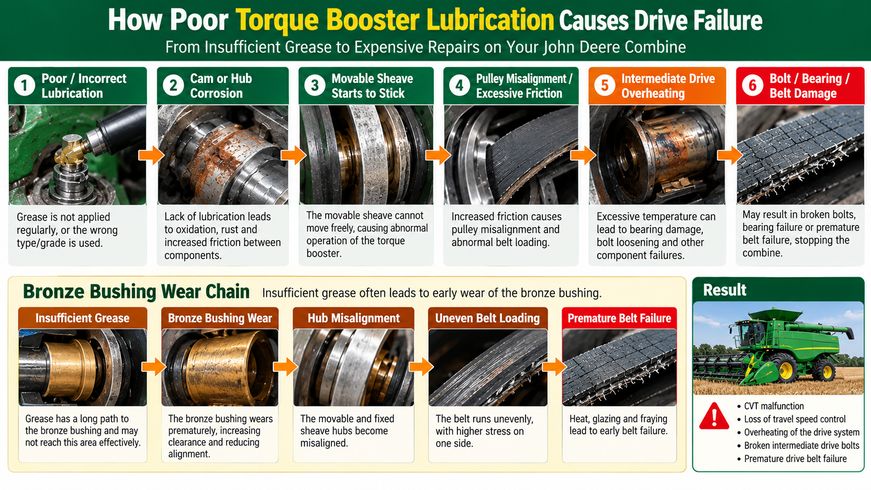
The movable-sheave hub and fixed-sheave hub operate under substantial contact pressure.
If Lubrication deteriorates, corrosion and friction can increase until the pulley can no longer move freely.
Common Failure 1: Torque Booster Seizes
A seized movable sheave prevents the CVT pulley from changing its effective diameter correctly.
Possible symptoms include:
- travel speed does not respond normally
- CVT ratio appears stuck
- machine cannot reach expected travel speed
- speed changes are delayed or jerky
- belt temperature increases
Before replacing the belt, check whether the pulley assembly moves freely.
Common Failure 2: Intermediate Drive Overheating
Insufficient Lubrication can increase friction throughout the pulley system.
Excessive heat around the intermediate drive assembly may therefore indicate more than a simple belt problem.
Inspect:
- pulley movement
- bearing condition
- belt tension
- cam lubrication
- sheave alignment
- bronze bushing wear
Repeated overheating after belt replacement is a strong reason to inspect the torque-booster mechanism itself.
Common Failure 3: Intermediate Assembly Bolts Break
If a pulley becomes partially seized or severely misaligned, abnormal loads can be transferred to the intermediate drive assembly.
This may loosen or fail its mounting hardware.
Replacing broken bolts without correcting the pulley or alignment issue can cause another failure.
Common Failure 4: Engine-to-Intermediate Drive Belt Breaks
A belt may fail because of age or normal wear, but premature belt failure can also be caused by:
- seized sheaves
- incorrect pulley alignment
- abnormal belt tension
- overheated bearings
- damaged pulley surfaces
- restricted torque-booster movement
If a recently installed belt fails again, inspect the entire drive system instead of replacing only the belt.
Why the Bronze Bushing Often Wears Prematurely
The bronze bushing between the movable and fixed hubs deserves special attention.
A relatively long grease path can exist between the external grease fitting and the bushing. Because the operating clearance between the bushing and hub is small, thick or deteriorated grease may not distribute adequately to the contact surface.
Poor Lubrication can lead to:
Insufficient grease → bronze bushing wear → excessive radial clearance → sheave misalignment → uneven belt loading → heat and accelerated belt wear
Once significant bushing wear exists, adding grease will not correct the mechanical clearance.
Inspect the bushing and related hub surfaces for wear.
Torque Booster Inspection Checklist
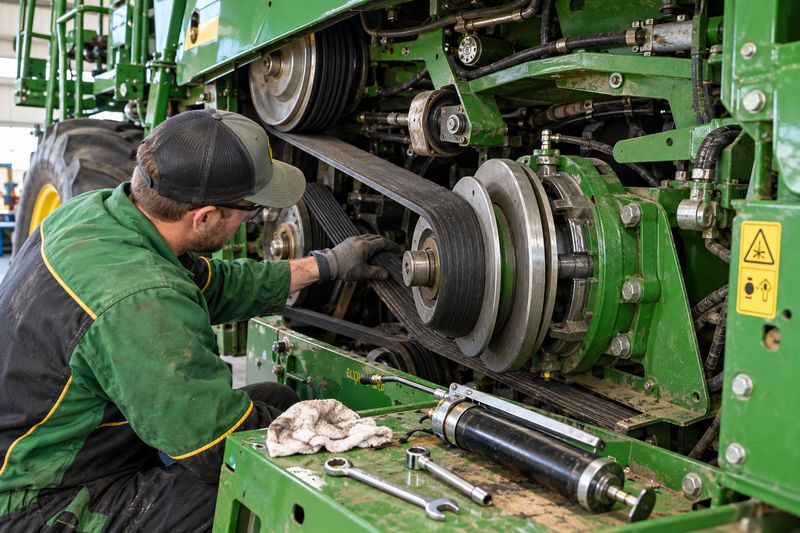
When servicing the combine, check the following areas:
| Component | What to Check |
|---|---|
| Springs | Rust, breakage and free movement |
| Needle roller bearing | Grease, roughness and excessive play |
| Cam surfaces | Lubrication, scoring and abnormal wear |
| Bronze bushing | Clearance and wear |
| Movable sheave | Smooth axial movement |
| Fixed sheave | Surface damage and overheating |
| Drive belt | Cracks, glazing, fraying and uneven wear |
| Pulley alignment | Belt tracking and hub alignment |
| Intermediate assembly | Loose or damaged mounting bolts |
| Hydraulic speed control | Correct cylinder movement and leakage |
Troubleshooting a Combine With Abnormal CVT Operation
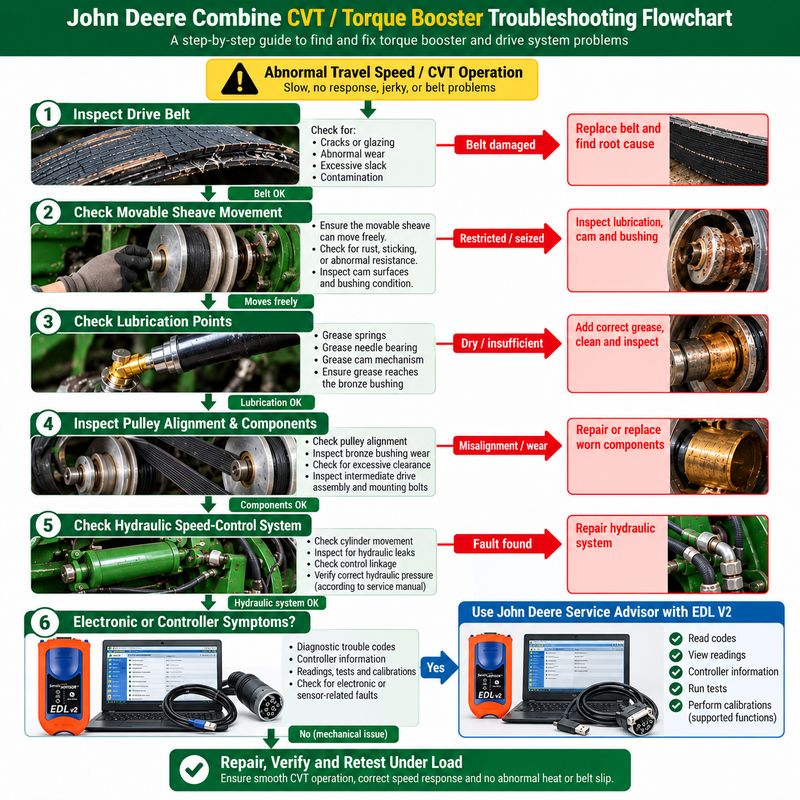
If the combine cannot adjust travel speed normally, use a systematic diagnostic process.
Step 1: Inspect the Belt
Look for:
- glazing
- cracking
- abnormal side wear
- excessive slack
- heat damage
- contamination
Do not assume that a damaged belt is the original cause.
Step 2: Check Pulley Movement
With the machine safely shut down and isolated per the service procedure, check whether the movable sheave moves normally.
Restricted movement can indicate:
- rust
- damaged cam surfaces
- dried grease
- bushing wear
- bearing damage
Step 3: Inspect Lubrication Points
Verify that grease is actually reaching the intended component.
Grease around the fitting does not necessarily mean the remote internal bushing is adequately lubricated.
Step 4: Inspect for Misalignment
Look for:
- uneven belt wear
- abnormal pulley contact
- excessive bushing clearance
- damaged mounting hardware
Step 5: Check the Hydraulic Control System
If the mechanical pulley assembly moves correctly, inspect the hydraulic system controlling the variable-speed mechanism.
Possible problems include:
- hydraulic leakage
- restricted oil flow
- control-cylinder problems
- linkage faults
- control-system faults
When John Deere Service Advisor Can Help
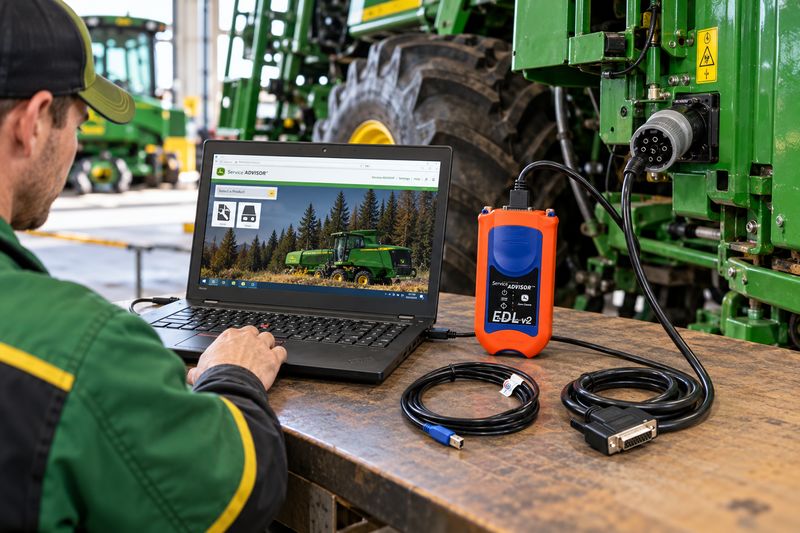
Mechanical inspection remains essential for pulley, belt, and lubrication problems. However, when the combine also shows electronic, hydraulic-control, or controller-related symptoms, diagnostic information can help narrow the problem.
OBD2TOOL currently offers John Deere Service Advisor 5.4.84 [05.2026] Agricultural + Construction & Forestry Diagnostic Software and Technical Manuals.
Depending on the machine and configuration, Service Advisor can provide access to information such as:
- diagnostic trouble codes
- controller information
- readings
- tests
- calibrations
- service procedures
- electrical information
- hydraulic information
- repair documentation
For live machine communication, you also need a compatible diagnostic interface.
John Deere EDL V2 Diagnostic Kit
OBD2TOOL also provides the Service Advisor EDL V2 for John Deere Electronic Data Link Diagnostic Kit with Service Advisor AG + CF software.
The EDL interface provides the PC-to-machine communication connection used for supported Service Advisor diagnostic functions.
Before ordering, confirm compatibility with the exact John Deere model, serial number, and required diagnostic function.
Diagnostic hardware and offline Service Advisor software do not automatically provide unrestricted John Deere dealer, online-security, or controller-programming authorization. Functions requiring dealer credentials remain dependent on authorized access.
Service Advisor vs. Parts Advisor
These two applications serve different purposes.
John Deere Service Advisor is primarily used for:
- troubleshooting
- diagnostic information
- service procedures
- electrical and hydraulic information
- tests and calibrations on supported equipment
John Deere Parts Advisor is primarily useful when technicians need:
- parts identification
- exploded component diagrams
- assembly references
- part-number research
For a torque-booster repair, Service Advisor can help with service and diagnostic information, while Parts Advisor can help identify individual pulley, bearing, bushing, belt, and mounting components.
Final Maintenance Advice
Many torque-booster failures begin as lubrication problems rather than catastrophic component failures.
The most important preventive measures are simple:
- lubricate the specified points at the correct intervals
- use the correct grease specification
- make sure grease reaches the internal cam and bushing surfaces
- inspect the pulley whenever abnormal heat develops
- investigate repeated belt failures instead of replacing belts repeatedly
- replace worn bushings or bearings before they cause severe misalignment
- verify repairs by checking that the CVT changes ratio smoothly under load
Correct Lubrication of the torque booster can significantly reduce the risk of seized sheaves, worn bushings, overheating, broken mounting hardware, and premature drive-belt failure.
For electronic troubleshooting or service information on supported John Deere agricultural equipment, a compatible John Deere Service Advisor + EDL diagnostic setup can complement the mechanical inspection process.